Isn't backtesting enough?
01+
Backtesting tells you how a strategy would have performed on historical data — keep doing it. But history contains only one order of events per day. The failures that cost money usually need an unusual order of events: a fill arriving between two confirmations, a cancel that crosses a fill, a hedge that comes back late. The verifier checks every order of events your rules allow, so it finds those before the market does.
Do I need to know formal methods or advanced maths?
02+
No. You state rules in plain terms — “never hold more than 1,000 shares”, “nothing trades after the kill switch”, “never buy more than the parent order”. You get back PROVEN, or the exact step-by-step sequence that breaks the rule. Our team can help you turn your existing risk policy into rules.
Can your team help us evaluate it?
03+
Yes. Tell us what you trade and which limits matter most, and we'll help you set up the free trial and write your first rules. Your code never needs to leave your network.
How long does a check take?
04+
Most checks finish in seconds to a few minutes on a laptop. A position limit was proved for 100,000 simultaneous orders in under half a second; a limit across 16 exchanges in 21 seconds.
What happens if it finds a problem?
05+
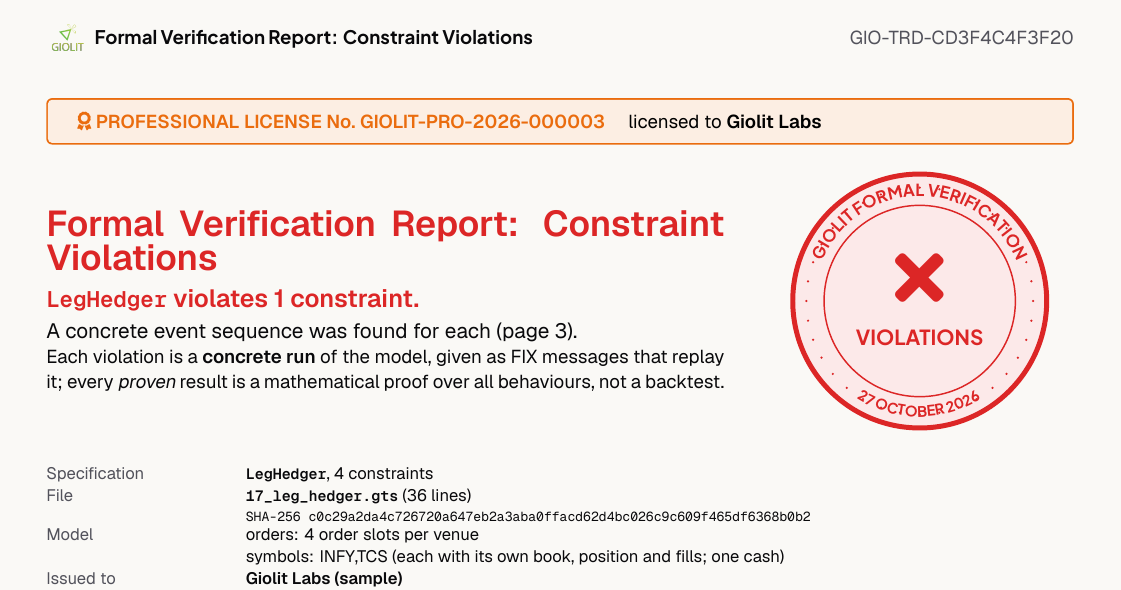
You get the exact sequence of events that breaks the rule — usually 3 to 15 steps — as a readable report and as a replay file your developers can load into their own tools. They fix it, you run the check again, and the fix is proved.
Do you issue certificates?
06+
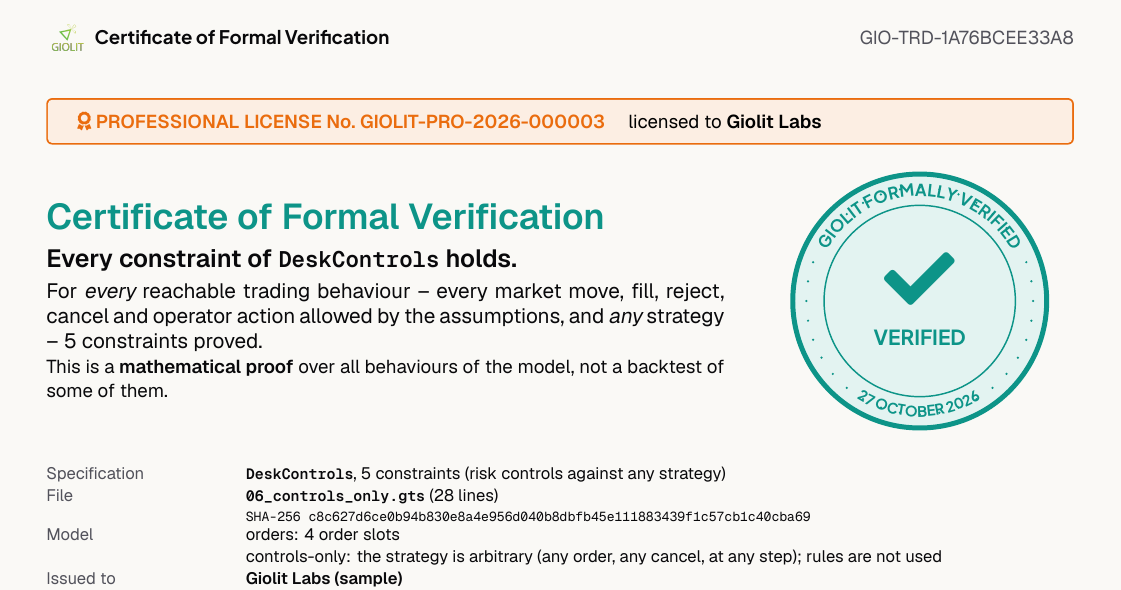
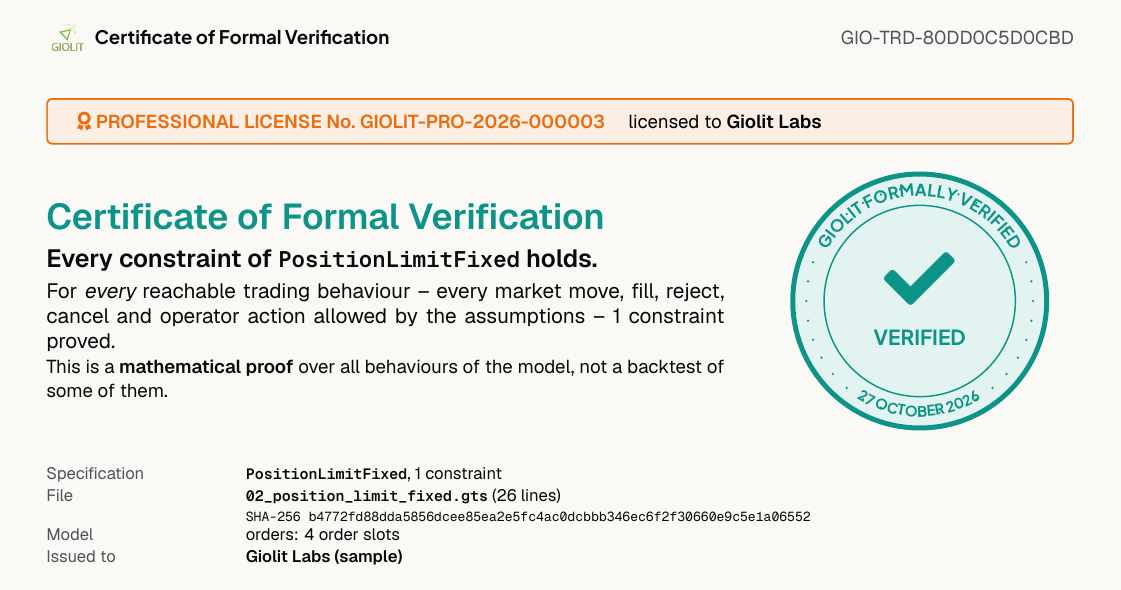
Yes. When every rule holds, the licensed edition issues a signed Certificate of Formal Verification: each rule and its verdict, the proof, the safety margin for every limit, and SHA-256 hashes of the specification and evidence, signed under your licence. Your exchange, auditor or customer can check it offline without our tool. Giolit can also verify your strategy or risk gateway and issue the certificate for you.
Does it replace our risk team or our backtests?
07+
No. Backtests measure profit; the verifier guarantees rules. It gives your risk, compliance and engineering teams evidence they cannot get from testing alone.
How do you test a trading algorithm before it goes live?
08+
Use three layers: backtest for performance, paper-trade or test in an exchange mock session for connectivity, and verify the risk rules against every possible sequence of orders, fills, cancels and market moves. Only the last layer covers the rare timing cases behind most costly incidents.
How do you test a kill switch?
09+
Prove two things: after the switch is pulled, no new order can leave on any venue — including orders triggered by fills that arrive afterwards — and every working order gets a cancel. The verifier checks both for every order of messages, and shows the exact sequence if either can fail.
Does SEBI require retail algos to be approved by the exchange?
10+
Yes. Under SEBI's circular of 4 February 2025 on safer participation of retail investors in algorithmic trading — applicable to all brokers from 1 April 2026 — brokers are responsible as principals for the algos they offer, each algo needs exchange approval and a unique identifier, and changes need fresh approval. The verifier helps produce testing evidence for those approvals; it does not by itself make a firm compliant.
Which pre-trade risk controls can it verify?
11+
Maximum order size and value, price bands and collars, position and exposure limits (per symbol, per venue, net, gross and beta-weighted), market-order bans, kill switches, and no-overfill rules for execution algos and smart order routers — the controls listed in FIA's automated-trading guidance, SEC Rule 15c3-5 and MiFID II RTS 6.
Can a broker check a client's algo without seeing its code?
12+
Yes. The verifier can treat the client algo as completely unknown — able to send any order or cancel at any moment — and prove your pre-trade limits still hold. No client code, no strategy secrets, nothing to disclose.
Which languages and strategies does it support?
13+
Strategies in C++, Python or Java are read directly from their source code — never executed — or described in a short rule file. Built-in templates cover market making, TWAP, VWAP, POV, pairs, lead–lag, delta hedging, smart order routing and pre-trade risk gateways. Five open-source strategies from Hummingbot and WonderTrader were checked from unmodified code.
Does our code or data leave our machines?
14+
No. Every engine is Giolit's own — no third-party solver, no cloud, no upload — and it adds nothing to your live trading path: checks run offline, before release.
What is in the free trial?
15+
1000 checks within 50 days on one Ubuntu 24.04 computer: the trade-verify tool, 22 worked examples (each bug next to its fix), 9 strategy templates, the full 180-rule benchmark with every result, and the brochure, tutorials and reference manual. Trial reports are watermarked; signed certificates come with a licence.